In three volumesEMMA
Jane Austen
“Emma, in three volumes again.”
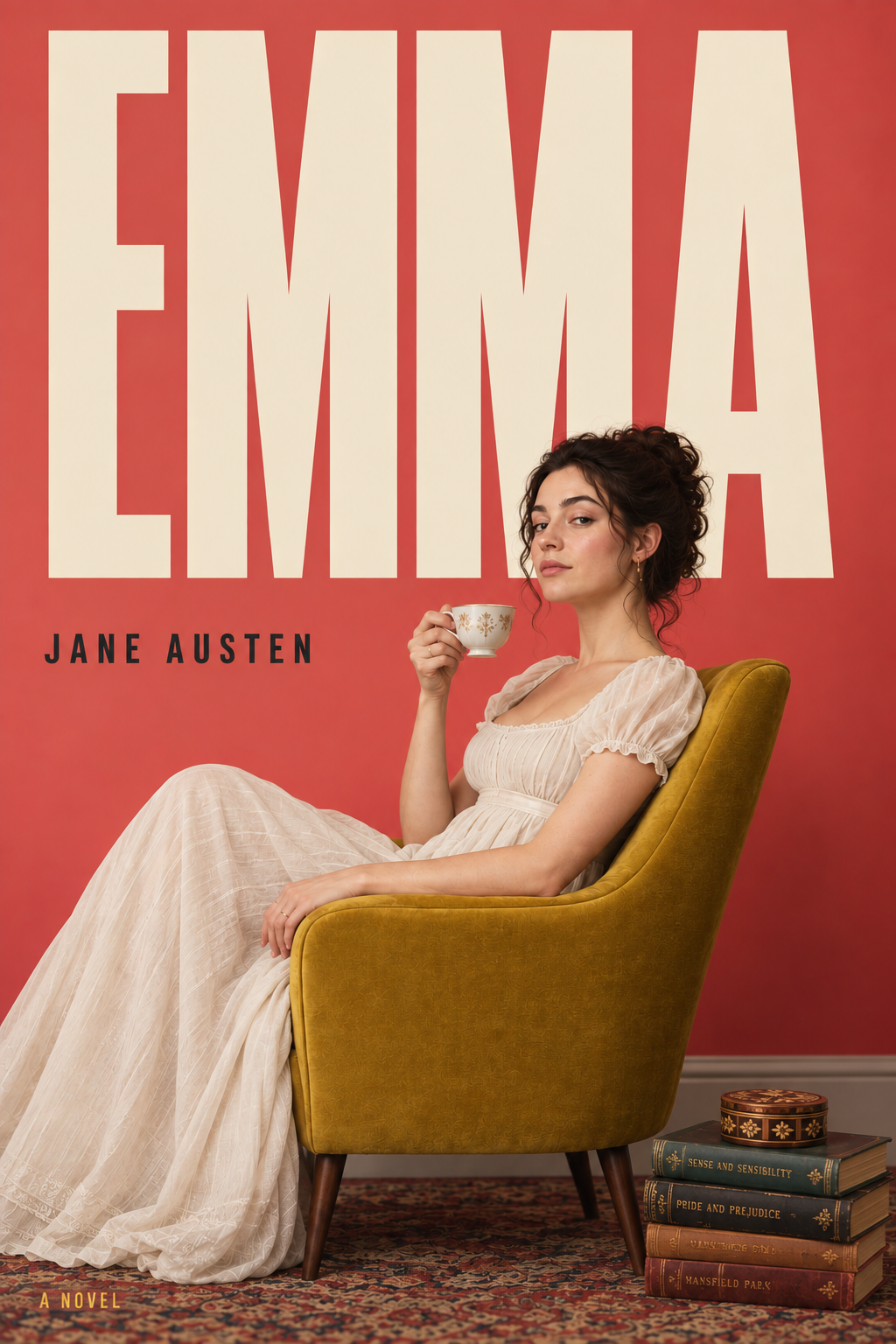
First published by John Murray in three volumes in 1816, Emma has spent almost all of its modern publishing life compressed into one. This edition restores the original three-volume structure for ordinary readers.
Why three volumes
The pause is the point.
The three volumes are not decorative nostalgia. Physical volume endings force a pause — and the pauses are built into the shape of the story.
At the end of Volume I, Emma’s confident interpretation of Mr Elton collapses. The reader closes the book and sits with it before beginning Volume II.
In modern one-volume editions, that boundary can shrink to a page turn. This edition restores a reading rhythm experienced by the novel’s earliest readers.
The structure
Three physical volumes.
Many modern editions renumber Emma as a continuous sequence of 55 chapters. This edition restores the original volume divisions and chapter numbering, as the novel first appeared.
Volume I
XVIII Chapters
Volume II
XVIII Chapters
Volume III
XIX Chapters
The text
Small changes accumulate.
Across two centuries of reprints, spelling, punctuation and presentation have quietly shifted. Compare a modern paperback with an early copy and the differences are everywhere:
- chusechoose
- shewshow
- connexionconnection
Early spelling → later standardisation
This edition aims to preserve early textual features rather than silently modernising them — so readers can see the novel as its first readers did. It is an edition still being researched: textual decisions are documented in the editorial note rather than made invisibly.
Why this Emma?
There are hundreds of editions of Emma. I couldn’t buy the one I wanted.
I wanted three volumes. I wanted the original volume divisions. I wanted chuse. I wanted to understand why punctuation had changed. And I wanted an edition that treated Emma Woodhouse as a young woman rather than an historical ornament.
So I made it.
Aaron D. Stott
Edited and designed by Aaron D. Stott / Alfie Charlie Press.
A short history
Three volumes, mostly lost.
1816
John Murray, first edition
The first edition, in three volumes — issued in December 1815 with 1816 title pages.
1994
Routledge / Thoemmes Press facsimile
Emma reproduced in three volumes as part of a nineteen-volume Austen facsimile collection, limited to 75 sets.
Miniature
Plum Park Press
A specialist three-volume miniature Emma, produced for collectors of tiny books.
Today
This edition
Full-size, readable and standalone — three physical volumes. A rare modern return to the original form; research into the publishing history is ongoing.
The edition
The details.
- Format
- Three paperback volumes
- Size
- Approx. 4.25 × 7 inches
- Structure
- Original 18 / 18 / 19 chapter structure
- Text
- Early spelling retained
- Notes
- Textual & editorial note included
Purchase
Coming soon
Purchase links will appear here when the edition is ready. No prices or dates have been announced yet.
When it’s ready.
Leave your email and I’ll send you one message when Emma in Three Volumes is available.
No newsletter. No regular emails. Just the publication notice.
Your address is used only for that one message and is not shared.